
Server-side translation indexes better than client-side scripts because search engines crawl static HTML directly. Client-side scripts often hide text behind JavaScript execution, which crawlers may skip or delay. Proxylang generates dedicated language pages that search engines can index immediately. This guide covers hreflang implementation, indexing mechanics, and how to choose the right approach for your site. For additional details, review the Just a moment.
hreflang Implementation
hreflang is an HTML attribute that tells search engines which language and region a page targets. Proper implementation requires reciprocal links between all language versions of a page. For example, an English page must link to its Japanese counterpart, and the Japanese page must link back to the English version. This creates a closed loop that helps Google and Bing understand your site structure. For additional details, review the .
Common hreflang Mistakes
Proxylang hreflang Handling
Proxylang automatically generates hreflang tags for all language pages it creates. When you add a new language, the system updates the hreflang attributes on every existing page to include the new version. This eliminates manual maintenance and reduces the risk of broken reciprocal links. The tags are injected into the HTML head section, which is the most reliable placement for search engine parsing. For additional details, review the Customer Experience.
Indexing Mechanics
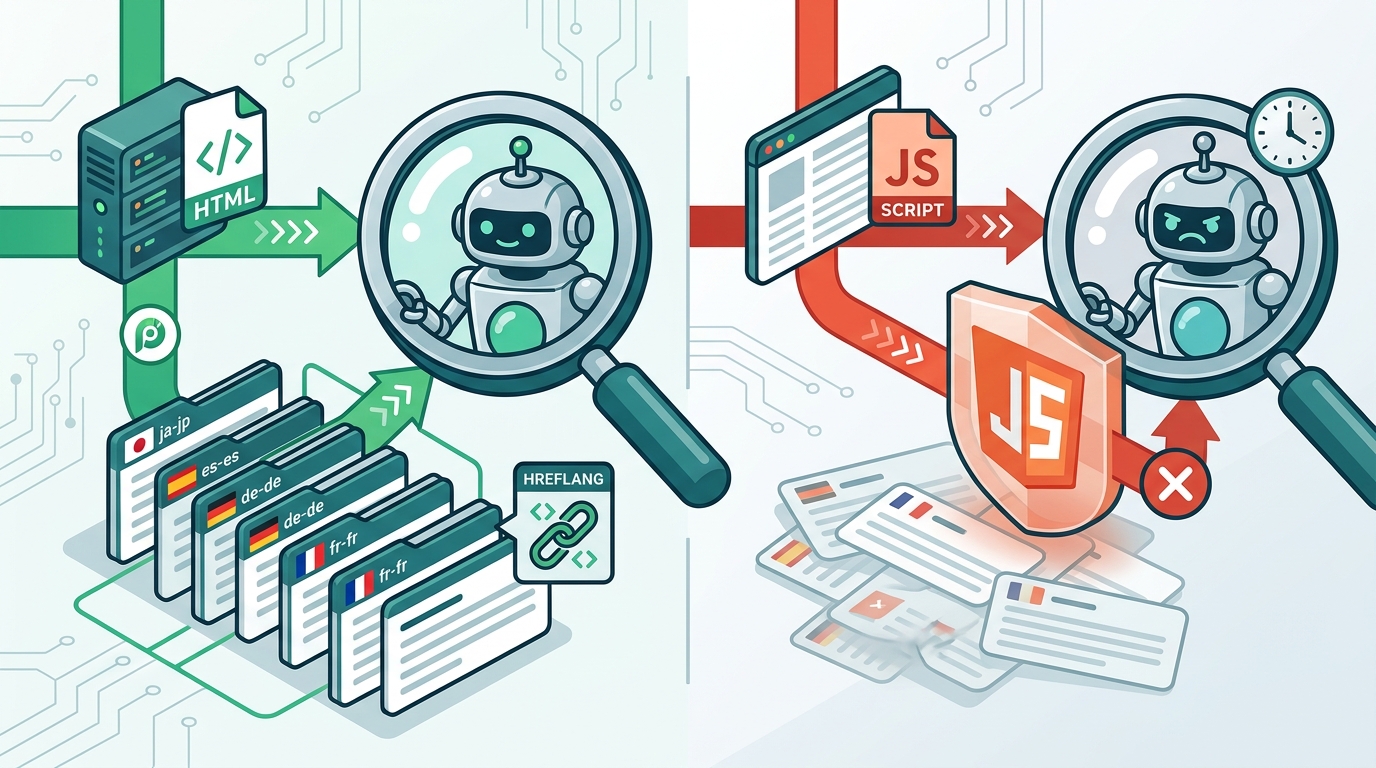
Search engines index content by crawling HTML documents and parsing the text within them. Server-side translation delivers fully rendered HTML to crawlers, making the content immediately visible and indexable. Client-side translation relies on JavaScript to swap text after the page loads, which requires additional processing steps from the crawler. For additional details, review the Frequently Asked Questions.
How Google Crawls JavaScript
Google can execute JavaScript, but it does so with a delay. The initial crawl fetches the raw HTML, then a second pass renders the JavaScript to see the final content. This two-step process means client-side translated content may take longer to index. Other search engines like Bing and Naver have less robust JavaScript rendering capabilities, making client-side translation less reliable for international SEO.
Indexing Speed Comparison
Server-side pages typically index within hours of deployment. Client-side pages may take days or weeks to fully index, depending on the search engine and crawl frequency. For time-sensitive campaigns or new market launches, this delay can be significant. Proxylang deploys language pages as static HTML, ensuring fast indexing across all major search engines.
Client-Side Limitations
Client-side translation scripts inject translated text into the DOM after the page loads. While this approach is easy to implement, it creates several SEO challenges. The original HTML contains the source language text, and the translated text only appears after JavaScript execution. This mismatch can confuse search engines and lead to duplicate content issues.
Duplicate Content Risks
When a client-side script translates text, the server still serves the original language HTML. Search engines may see multiple versions of the same content, one in each language, without clear signals about which is the canonical version. This can dilute ranking signals and cause pages to compete against each other. Proper canonical tags and hreflang attributes can mitigate this, but they add complexity to the implementation.
Crawler Compatibility Issues
Not all search engines handle JavaScript rendering equally well. While Google has a robust rendering engine, smaller search engines and AI assistants may not execute JavaScript at all. This means client-side translated content may be invisible to these systems. For businesses targeting markets where local search engines dominate, such as Naver in South Korea or Baidu in China, client-side translation is often ineffective.
Server-Side Advantages
Server-side translation generates separate HTML pages for each language, each with its own URL. This approach provides clear, distinct content for search engines to index. Each language page is a standalone document with its own metadata, hreflang tags, and canonical references. This structure aligns with how search engines expect to find and rank international content.
URL Structure and Crawlability
Metadata and Structured Data
Comparison Table
| Indexing Speed | Fast, typically hours | Slow, days to weeks |
| JavaScript Dependency | None | Required |
| URL Structure | Dedicated language URLs | Single URL with query parameters |
| Crawler Compatibility | All search engines | Google primarily, limited others |
| Metadata Control | Full per-language control | Limited, shared metadata |
| Implementation Complexity | Higher, requires server changes | Lower, single script tag |
| Best For | International SEO, multi-market sites | Quick translation, single-market sites |
Key Takeaways
- Server-side translation indexes faster and more reliably than client-side scripts.
- Client-side translation relies on JavaScript execution, which not all search engines support.
- Dedicated language URLs improve crawlability and user experience.
- Server-side pages allow for localized metadata and structured data optimization.
- Proxylang automates hreflang generation and language page creation.
- For multi-market SEO, server-side translation is the recommended approach.
- Client-side translation may still be useful for quick, low-stakes translation needs.
Frequently Asked Questions
Does Google index client-side translated content?
Yes, Google can index client-side translated content, but with a delay. Google executes JavaScript in a second crawl pass, which means the translated text may take longer to appear in search results. Other search engines may not execute JavaScript at all, making client-side translation less reliable for international SEO.
What is the difference between server-side and client-side translation?
How does Proxylang handle hreflang tags?
Proxylang automatically generates and maintains hreflang tags for all language pages. When you add a new language, the system updates the hreflang attributes on every existing page to include the new version. This ensures reciprocal links and reduces the risk of broken hreflang implementations.
Can I use client-side translation for SEO?
You can use client-side translation for SEO, but it is less effective than server-side translation. Client-side translation relies on JavaScript execution, which not all search engines support. For multi-market SEO, server-side translation is the recommended approach. Client-side translation may be suitable for single-market sites or quick translation needs.
How long does it take for server-side translated pages to index?
Server-side translated pages typically index within hours of deployment. The exact time depends on the search engine and crawl frequency, but it is generally much faster than client-side translation. Proxylang deploys language pages as static HTML, ensuring fast indexing across all major search engines.
Do I need to manually create language pages?
No, Proxylang creates language pages automatically. When you add a new language, the system generates the corresponding HTML pages with translated content, hreflang tags, and metadata. You can edit any translation in a live editor, and the changes are reflected on the live site immediately.
What search engines support client-side translation?
Can I switch from client-side to server-side translation later?
Conclusion
Server-side translation indexes better than client-side scripts for search engines. The dedicated HTML pages, fast indexing, and full metadata control make it the superior choice for international SEO. Proxylang automates the entire process, from hreflang generation to language page creation, so you can focus on growing your business in new markets. To get started, visit Proxylang and see how easy it is to make your website ready for global audiences.