
Server-side translation indexes better than client-side scripts because search engines receive fully rendered HTML at unique URLs. Client-side scripts modify text in the browser after the page loads, leaving the original language visible to crawlers. This guide explains how Proxylang handles both methods, why hreflang tags matter, and how to choose the right architecture for your global growth strategy.
hreflang Implementation
hreflang is a link element that tells search engines which language and region a page targets. It is the primary signal for multilingual SEO, especially for Google. Without correct hreflang tags, search engines may treat translated pages as duplicates or fail to serve the right version to users in specific regions.
Why hreflang Matters for Indexing
When you publish a page in English and Spanish, you must signal that relationship. The hreflang tag creates a bidirectional link between the original and translated versions. This prevents content cannibalization and ensures users see the version in their preferred language. For sites targeting multiple regions, such as the US and Canada, hreflang also specifies the geographic target using the x-default attribute.
Proxylang's Automatic hreflang Generation
Proxylang automatically generates and manages hreflang tags for every language you enable. This removes the manual burden of updating tags whenever you add a new language or page. The system ensures that every translated page points back to the original and all other language variants, maintaining a complete and accurate link graph for search engines.
Server-Side Translation Advantages
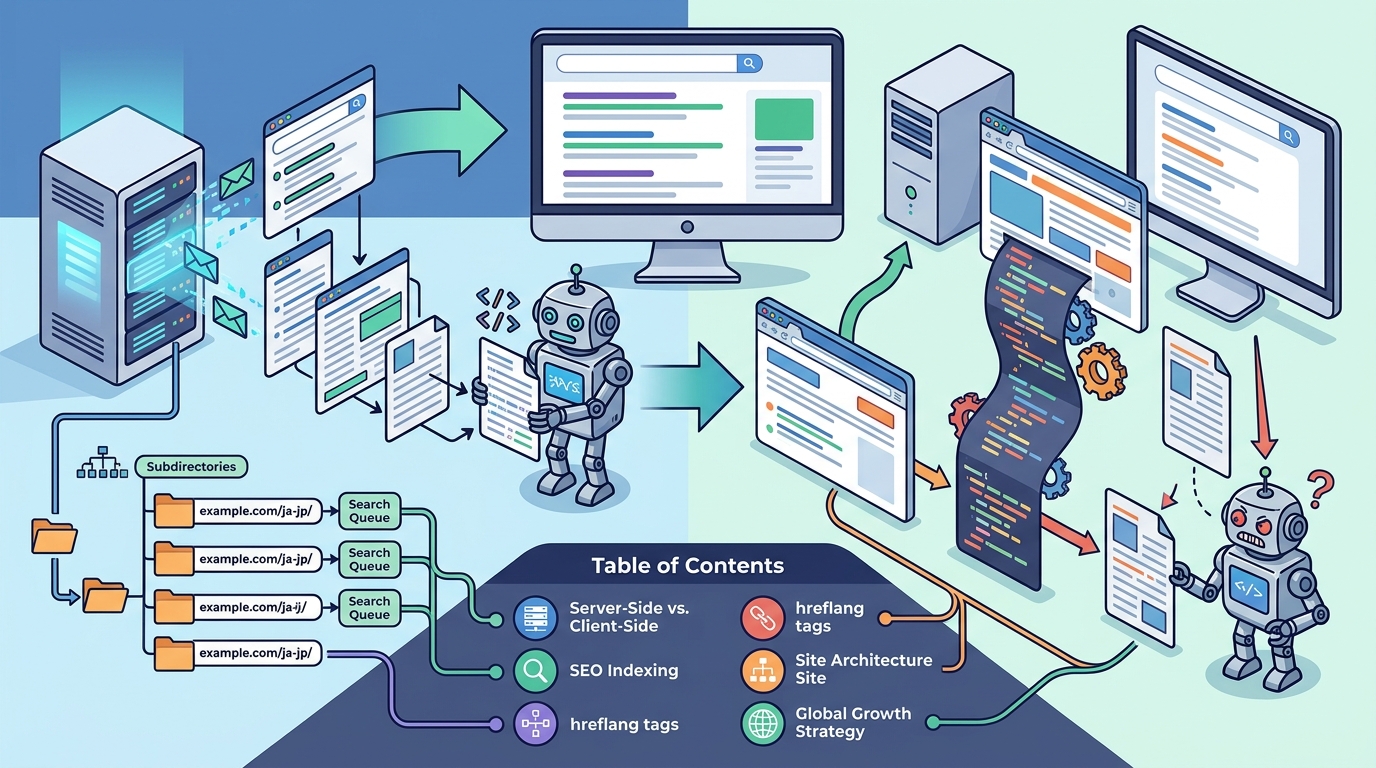
Server-side translation, often implemented via a proxy, serves translated HTML directly from the server. This method is superior for indexing because crawlers receive the final, translated content without executing JavaScript. The page is fully rendered before it reaches the browser, ensuring that all text, metadata, and structured data are visible to search engine bots.
Real HTML at Unique URLs
Server-side translation typically assigns a unique URL to each language, such as /es/ or /ja-jp/. These URLs are indexable and inherit the authority of your main domain. Because the content is served as standard HTML, search engines can crawl, index, and rank these pages just like any other native-language page. This is critical for markets where search engines do not execute JavaScript effectively.
Metadata and Structured Data
Search engines rely on meta titles, descriptions, and structured data to understand page content. Server-side translation updates these elements in the HTML head, ensuring that search results display the correct language and relevant snippets. Client-side scripts often fail to update these metadata fields, leading to mismatched search results where the title is in English but the page content is in Spanish.
Client-Side Script Limitations
Client-side translation uses JavaScript to swap text in the browser after the page loads. While this method is easy to implement and fast for users, it has significant limitations for SEO. Search engines may not execute the JavaScript, or they may index the original language content before the script runs. This results in translated pages that are not properly indexed or ranked.
JavaScript Execution Risks
Not all search engines execute JavaScript with the same reliability. Google has a robust JavaScript rendering engine, but other engines, such as Baidu or Naver, may not render client-side changes at all. If your target market relies on a search engine that does not execute JavaScript, client-side translation will not make your site visible in that market. This is a critical consideration for businesses targeting Asia or other regions with dominant local search engines.
Indexing Delays and Inconsistencies
Even when search engines do execute JavaScript, there can be delays in indexing the rendered content. This leads to inconsistencies where some pages are indexed in the original language and others in the translated language. Over time, this can confuse search engines and reduce the overall authority of your multilingual site. Client-side translation is best suited for user experience improvements rather than as a primary SEO strategy.
The Hybrid Approach
A hybrid approach combines the speed of client-side translation with the indexing benefits of server-side rendering. This method serves pre-rendered HTML to search engines while using JavaScript to provide instant language switching for users. It is the best of both worlds, ensuring that your site is fully indexable while maintaining a seamless user experience.
How Hybrid Mode Works
In hybrid mode, the server detects the user agent. If the request comes from a search engine crawler, it serves the pre-rendered, translated HTML. If the request comes from a user's browser, it serves the original HTML with a JavaScript widget that allows instant language switching. This ensures that search engines see the correct content while users enjoy a fast, interactive experience.
Proxylang's Hybrid Implementation
Proxylang offers a hybrid mode that is available on its Lite plan and above. This mode allows you to serve translated pages to search engines without changing your DNS settings. It is an ideal solution for businesses that want to improve their SEO in new markets without the complexity of a full reverse proxy setup. The hybrid approach ensures that your translated content is visible to all major search engines, including those that do not execute JavaScript.
Search Engine Behavior by Region
Different search engines handle multilingual content and JavaScript rendering differently. Understanding these differences is crucial for choosing the right translation architecture. The table below summarizes how major search engines treat hreflang tags, Content-Language headers, and JavaScript rendering.
| Search Engine | Primary Signal | JavaScript Rendering | Best Translation Method |
|---|---|---|---|
| hreflang | High | Hybrid or Server-Side | |
| Bing | Content-Language | Medium | Server-Side |
| Naver (Korea) | Sitemap Registration | Low | Server-Side |
| Baidu (China) | Content-Language | Low | Server-Side |
| Yandex (Russia) | hreflang | Medium | Hybrid or Server-Side |
As shown in the table, server-side translation is the safest choice for markets where search engines have low JavaScript rendering capabilities. For Google, which has high JavaScript rendering, a hybrid approach can be effective. However, for maximum compatibility and indexing reliability, server-side translation is recommended for all markets.
Implementation Checklist
Before launching your multilingual site, ensure that you have addressed the following technical and strategic considerations. This checklist will help you avoid common pitfalls and ensure that your translated pages are properly indexed and ranked.
Technical Setup
- Verify that your chosen translation method serves fully rendered HTML to crawlers.
- Ensure that each language has a unique, indexable URL.
- Implement correct hreflang tags for all language variants.
- Update meta titles and descriptions for each language.
- Submit language-specific sitemaps to relevant search consoles.
Content and Quality
- Review translated content for accuracy and tone, especially for key pages.
- Pin brand names and product terms in a glossary to ensure consistency.
- Test the site in different languages to ensure layout and functionality are intact.
- Monitor search console reports for indexing issues in each language.
Key Takeaways
- Server-side translation indexes better than client-side scripts because it serves fully rendered HTML to search engines.
- hreflang is the primary signal for multilingual SEO and must be implemented correctly for all language variants.
- Client-side translation is limited by JavaScript execution capabilities, which vary significantly between search engines.
- A hybrid approach combines the speed of client-side switching with the indexing benefits of server-side rendering.
- Search engine behavior varies by region, with some engines like Baidu and Naver having low JavaScript rendering capabilities.
- Proxylang offers automatic hreflang generation and hybrid mode to simplify multilingual SEO implementation.
- Unique URLs for each language are essential for indexing and inheriting domain authority.
- Regular monitoring and content review are necessary to maintain high-quality translations and indexing performance.
Frequently Asked Questions
Does client-side translation work for Google?
Client-side translation can work for Google because it has a robust JavaScript rendering engine. However, it is less reliable than server-side translation and may lead to indexing delays or inconsistencies. For critical SEO, server-side or hybrid methods are recommended.
What is the difference between server-side and client-side translation?
Server-side translation serves translated HTML from the server, while client-side translation uses JavaScript to modify text in the browser. Server-side is better for SEO because search engines receive the final content without executing scripts.
How does Proxylang handle hreflang tags?
Proxylang automatically generates and manages hreflang tags for every language you enable. This ensures that all translated pages are correctly linked and indexed by search engines.
Can I use client-side translation for user experience and server-side for SEO?
Yes, this is known as a hybrid approach. It allows users to switch languages instantly via JavaScript while serving pre-rendered HTML to search engines. Proxylang offers this hybrid mode on its Lite plan and above.
Which search engines do not execute JavaScript well?
Search engines like Baidu and Naver have low JavaScript rendering capabilities. For these markets, server-side translation is essential to ensure that your content is indexed and visible.
Do I need unique URLs for each language?
Yes, unique URLs for each language are essential for indexing. They allow search engines to treat each language version as a separate page, which is necessary for proper ranking and hreflang implementation.
How do I choose the right translation method for my site?
Consider your target markets and the search engines they use. If you are targeting markets with low JavaScript rendering capabilities, use server-side translation. If you are targeting Google-centric markets, a hybrid approach may be sufficient. Proxylang can help you choose the right method based on your specific needs.
Conclusion
Choosing the right translation architecture is critical for your multilingual SEO success. Server-side translation offers the best indexing reliability, while client-side translation provides a faster user experience. A hybrid approach combines the benefits of both, making it an ideal solution for many businesses. Proxylang simplifies this process by offering automatic hreflang generation, hybrid mode, and server-side translation options. By understanding the differences between these methods and implementing the right strategy, you can ensure that your site is visible and ranked in all your target markets.