
Which Website Translation Source Is Best for Expanding Reach in Chicago?
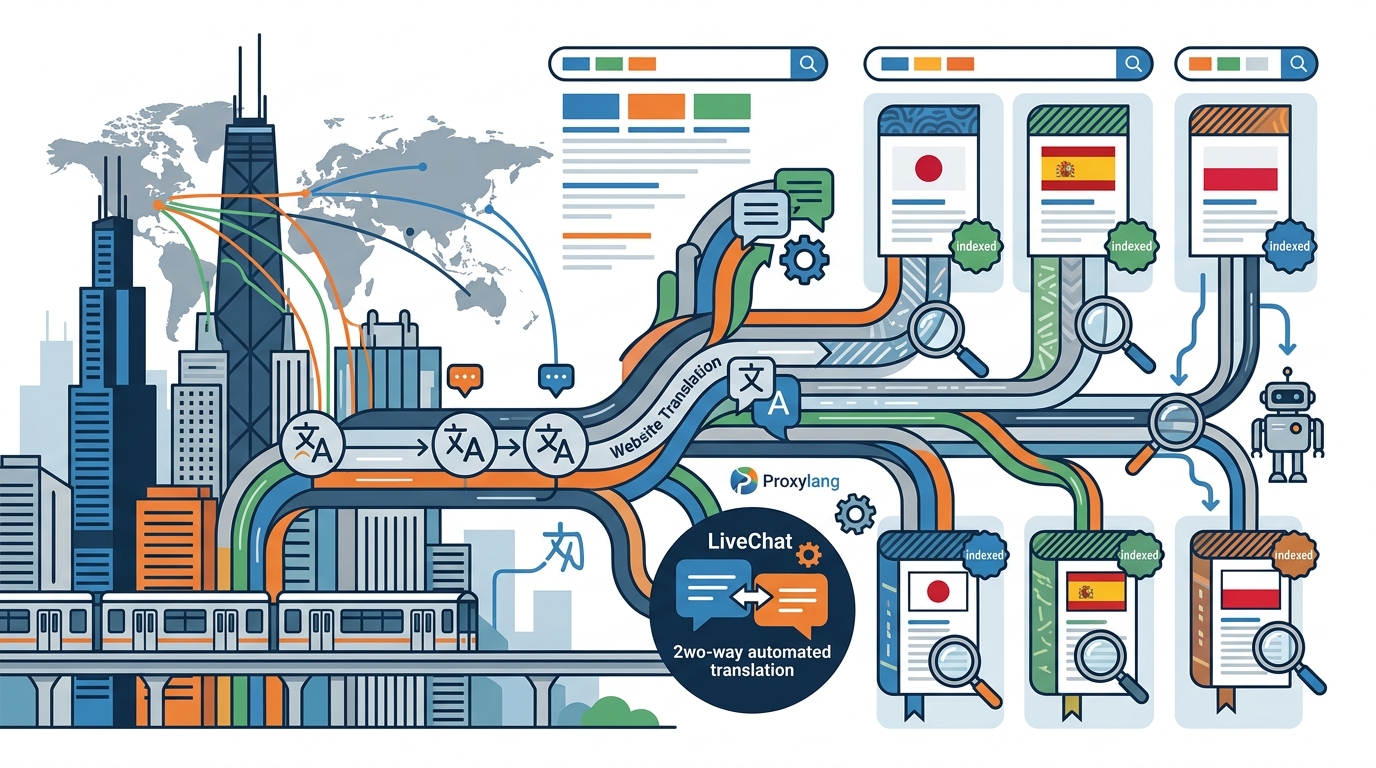
For Chicago businesses, the best website translation source is a platform that serves indexable, localized pages in the specific languages spoken by local and international visitors. Proxylang provides this by translating your site into 77+ languages, ensuring your content is readable and discoverable in search engines. This guide covers Chicago language demographics and the essential features of translation platforms to help you choose the right tool.
Chicago Language Demographics
Chicago is one of the most linguistically diverse cities in the United States. Understanding who speaks what is the first step in choosing a translation strategy. A website that only supports English misses a significant portion of the local market and international visitors who search for Chicago services in their native tongues.
Major Language Groups in the Region
While English remains the dominant language, several other languages have substantial speaker bases in the Chicago metropolitan area. Spanish is the most widely spoken non-English language, with a large community of Hispanic and Latino residents. Polish has a historic presence in the city, particularly in neighborhoods like Pilsen and Jefferson Park. Other significant languages include Korean, Chinese For additional details, see Simplified and Traditional., Arabic, and Tagalog.
Why Demographics Matter for SEO
Language demographics directly influence search behavior. Residents and visitors often search for local businesses, such as restaurants, clinics, or real estate, in their preferred language. If your website is not available in these languages, you are invisible to these users. Furthermore, international visitors to Chicago, whether for tourism or business, rely on localized content to navigate the city. By targeting the specific languages prevalent in your area, you can capture organic traffic that competitors ignore.
Local vs. International Reach
Expanding reach in Chicago involves two distinct audiences: local residents who speak non-English languages and international visitors. Local residents need practical information, such as hours, locations, and service details, in their language. International visitors often look for broader context, such as travel guides or business directories. A robust translation strategy addresses both by providing accurate, localized content that serves the immediate needs of the user, regardless of their origin.
Translation Platform Features
Choosing the right translation source depends on the technical capabilities of the platform. Not all translation tools are created equal. Some rely on simple word-for-word substitution, while others use advanced AI to understand context. For a business looking to expand its reach, the platform must offer features that ensure quality, search visibility, and ease of management.
AI-Driven Contextual Translation
Modern translation platforms use AI to understand the context of a sentence rather than translating individual words. This is crucial for maintaining brand voice and ensuring accuracy. Proxylang, for example, uses AI to translate websites while allowing site owners to review and edit any translation. This hybrid approach ensures that the content is both efficient to produce and high-quality. Features like glossaries allow you to pin specific brand terms or product names, ensuring they remain consistent across all languages.
Search Engine Optimization (SEO) Integration
A translation platform must integrate seamlessly with search engines. This means generating localized URLs, such as /es/ or /ja-jp/, that search engines can index. It also involves adding hreflang tags to signal to search engines which language version of a page is being served. Proxylang supports these SEO features, ensuring that your translated pages are discoverable in local search results. Without proper SEO integration, your translated content may not appear in search results, rendering your expansion efforts ineffective.
Live Chat and Real-Time Interaction
Communication is a key part of customer experience. A translation platform that includes live chat capabilities allows you to interact with customers in their language. Proxylang offers LiveChat, which translates both ways in real-time. This means you can reply in your native language, and the customer sees the translation in theirs. This feature is particularly valuable for businesses that receive inquiries from international clients or local residents who prefer to communicate in their native language.
Comparison of Translation Approaches
| Feature | Manual Translation | Basic Machine Translation | AI-Powered Platform (e.g., Proxylang) |
|---|---|---|---|
| Cost | High | Low | Moderate |
| Speed | Slow | Instant | Instant |
| Contextual Accuracy | High | Low | High |
| SEO Integration | Manual | Limited | Automated |
| Maintenance | High Effort | Low Effort | Low Effort |
Image and Content Translation
Text is not the only element that needs translation. Images often contain text, such as banners, infographics, or product labels. Advanced platforms can translate text within images, ensuring that visual content is also localized. Proxylang includes this feature, allowing you to translate text inside images automatically. This level of detail is important for creating a fully immersive experience for your visitors.
Key Takeaways
- Chicago has a diverse linguistic landscape, with significant populations speaking Spanish, Polish, Korean, and Chinese.
- Targeting local language demographics can capture organic traffic that English-only sites miss.
- AI-powered translation platforms offer a balance of speed, cost, and contextual accuracy.
- SEO integration, including localized URLs and hreflang tags, is essential for search visibility.
- Live chat translation facilitates real-time communication with customers in their native language.
- Manual translation is costly and slow, making it impractical for large-scale website localization.
- Basic machine translation often lacks contextual accuracy, which can harm brand perception.
- Choosing a platform with editing capabilities allows you to maintain brand voice and accuracy.
Frequently Asked Questions
Which languages should I prioritize for my Chicago website?
Start with Spanish, as it has the largest non-English speaker base in the region. Depending on your specific industry and neighborhood, you may also consider Polish, Korean, or Chinese. Analyze your website analytics to see which countries or languages your current visitors are using.
How does AI translation ensure accuracy?
AI translation uses context to understand the meaning of sentences rather than translating word-for-word. Platforms like Proxylang allow you to review and edit translations, ensuring that the final output matches your brand voice and is accurate.
Will translating my website help with local SEO?
Yes. By creating localized pages with proper hreflang tags and localized URLs, you can rank in search results for queries in those languages. This makes your site more visible to local residents and international visitors searching in their native language.
Can I translate text inside images?
Yes, advanced translation platforms can detect and translate text within images. This ensures that visual content, such as banners or infographics, is also localized for your audience.
How much does website translation cost?
Costs vary depending on the platform and the volume of content. AI-powered platforms typically offer subscription-based pricing, which is more cost-effective than manual translation for large websites. Proxylang offers plans that scale with your needs, starting with a free tier for smaller sites.
Do I need a developer to set up a translation platform?
Most modern translation platforms, including Proxylang, require minimal technical setup. You often just need to add a script tag to your website. This makes it accessible for business owners without extensive technical expertise.
How do I maintain translated content as my website changes?
AI-powered platforms automatically translate new or updated content. This ensures that your website remains consistent across all languages without requiring manual intervention for every change.
What is the difference between localization and translation?
Conclusion
Expanding your reach in Chicago requires a strategic approach to website translation. By understanding the local language demographics and choosing a platform with robust AI, SEO, and communication features, you can effectively connect with a wider audience. Proxylang offers a comprehensive solution that balances quality, ease of use, and search visibility. Start by identifying the key languages in your target market and explore how a modern translation platform can help you serve them better.
To begin your expansion, visit Proxylang and see how you can make your website accessible in 77+ languages.